Electric Greenhouse Heaters With Thermostat
As an Amazon Associate we earn from qualifying purchases. Some links on this page are affiliate links, which means we may earn a small commission if you make a purchase.
A thermostat placed in the heater’s warm airstream can actively waste money, cycling on when your greenhouse is already warm enough. The sensor reads the artificially heated air, not the ambient temperature your plants actually experience. This positioning error is why electricity bills can climb while frost damage still occurs in the corners furthest from the heater.
What follows is a UK-specific guide to choosing an electric greenhouse heater with a thermostat, based on greenhouse guidance, real owner feedback, and the practical constraints of a British winter. You’ll learn whether manual or digital thermostat control suits your setup, how to size the heater properly, and how to avoid common reliability pitfalls.
Our Pick
- Most UK gardeners with a 6x6 or larger greenhouse, or anyone growing tender plants Electric heater with digital thermostat — delivers tighter temperature bands and more reliable frost protection without constant manual adjustment.
- Small, well-insulated 6x4 setup with uniform, hardy plants and a tight budget Electric heater with manual thermostat — simple, no-power interface, but requires more attention to keep temperatures consistent.
The Thermostat Control Problem
Greenhouse guidance typically advises: “Look for one with a thermostat – while not always accurate, it gives you the ability to regulate the temperature.” That qualification — “not always accurate” — is what catches people out.
A thermostat provides rough control, not precise temperature management. Its sensor sits inside the heater housing, reading the air temperature at the unit itself. In a small, still space this discrepancy might be a degree or two. In a draughty greenhouse with cold spots, the difference can be enough that your thermostat reads 5°C while the air around your plants nears freezing.
Cheap thermostats sometimes suffer from calibration drift, gradually reading warmer than the actual greenhouse air over a season. If a heater runs constantly yet frost still forms, drift is the first thing to check. The fix is straightforward, but it requires awareness most buyers lack until it happens.
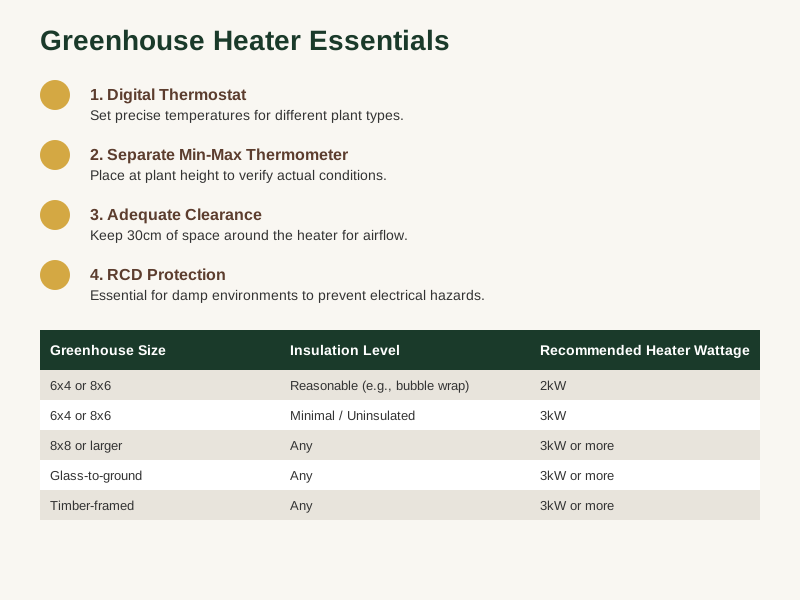
This highlights the essential need for a separate min-max thermometer placed at plant height, not beside the heater. Without it, you’re operating blind.
Greenhouses are humid environments, which changes the safety requirements. UK electrical safety guidance commonly recommends RCD (residual current device) protection for damp locations. If your greenhouse has its own circuit, it should already include this. When using an extension lead from an indoor socket, ensure it’s rated for outdoor use and consider a plug-in RCD adaptor. Domestic heaters lack the damp-proofing features needed for this environment.
Manual vs Digital: Which Control Works?
The core choice for most buyers comes down to manual or digital thermostats. The difference matters more than the price gap implies.
Manual thermostats operate like a central heating dial — you set a range, and the heater switches based on that single reading. They’re mechanically simple with no display or circuit board to fail. Crucially, they don’t require power to function. For a small greenhouse with uniform plant requirements, like keeping everything frost-free at similar temperatures, a manual thermostat suffices.
The limitation is precision. Manual units typically operate on a wider hysteresis band, allowing temperature swings of several degrees between cycles. For tender plants that struggle below 5°C, these swings stay within safe margins. For more demanding varieties, the control becomes insufficient.
Digital thermostats provide tighter temperature bands and specific target settings rather than approximations. The display shows the sensor’s reading, adjustable in 1°C increments. This granularity matters when growing a mix of plants with different cold-tolerance thresholds. You can maintain pelargoniums at 7°C without overheating alpines kept at 3°C.
The trade-off is dependency. Digital thermostats require stable power for their circuitry. Power fluctuations, display failures, or control board faults can disable temperature regulation entirely. A failure where the display blanks but the heater continues running means no control until you notice.
For most UK gardeners, digital proves worthwhile. The ability to set and maintain a target temperature justifies the added complexity, particularly for anyone growing valuable plants. Greenhouse guidance emphasises thermostat control specifically to match temperature to plant needs — digital achieves this more effectively than manual.
Manual thermostats remain a valid budget option for small (6x4 or 8x6), well-insulated greenhouses housing plants with similar requirements. In these conditions, manual control saves money upfront while maintaining frost protection. For larger, mixed, or more valuable setups, digital is the clear choice.
Getting Heater Wattage Right
Correct wattage matters more than brand reputation. An undersized heater will run constantly without maintaining temperature — the commonest problem with entry-level models.
UK supplier guidance and owner reports indicate a 2kW heater suffices for a 6x4 or 8x6 greenhouse with reasonable insulation. Glass-to-ground structures, timber-framed greenhouses, and anything 8x8 or larger typically require 3kW or more. A small, well-insulated 6x4 or 8x6 greenhouse generally requires a 2kW heater, while an uninsulated space of the same size, or any glass-to-ground or timber-framed greenhouse, will likely need 3kW or more.
Insulation significantly alters the calculation. A greenhouse lined with bubble wrap — particularly with large cells — retains heat far better than unlined glass. Owners consistently report that proper insulation reduces heating requirements by a kilowatt or more, making a struggling 2kW heater adequate in an 8x6 space once insulation is added.
If your 2kW heater struggles in a poorly insulated space, address insulation before upgrading the heater.
For most hobby setups, 2kW is sufficient. With large timber structures, glass-to-ground designs, or minimal insulation, step up to 3kW. Trying to force a 2kW unit into an oversized space is a false economy — constant maximum operation accelerates wear without reliably preventing frost on the coldest nights.
Reliability Patterns from User Feedback
No brand is flawless, and buyer reviews reveal more nuance than product listings suggest. Here’s what owners report about commonly available models.
BioGreen Palma 1500W heater with digital thermostat (paid link): This is a 1500W greenhouse fan heater, not a 2kW unit. The digital thermostat holds a target when it is working, and the footprint is small, which matters in a crowded 6x4. 1500W is the edge of enough for that size once the glass is insulated.
Check BioGreen Palma 1500W price → (paid link)
However, reliability is a risk with digital thermostat units: a unit can fail early, or develop thermostat calibration drift where the sensor reads warmer than the actual air. A safety shutoff that trips unexpectedly often relates to airflow — the unit needs adequate clearance, and in cluttered greenhouses with pots stacked nearby, overheating can occur. The Palma suits small, organised spaces where airflow around the heater isn’t restricted.
**DAHTEC 2000W ceramic fan heater with thermostat (paid link): This is a portable 2000W ceramic fan heater with a thermostat, not a greenhouse tube. It is a lot of heat for a small house and a reasonable top-up where you already have insulation. It is not a gentle background heater.
Check DAHTEC 2000W ceramic fan heater with thermostat price → (paid link)
Treat this as a supplementary heater rather than a primary winter solution; relying on it as your main greenhouse heater invites shorter life and constant cycling. For taking the edge off a cold snap rather than maintaining frost-free conditions through winter, the DAHTEC represents a reasonable choice.
Ensure adequate greenhouse ventilation before using any fan heater. Blocked airflow is the most common cause of safety shutoff failures across brands. Provide generous clearance on all sides, and avoid positioning where expelled air directs straight at the glass.
Accurate Temperature Monitoring
Your heater’s thermostat is a control device, not a monitoring tool. To know what temperatures your plants actually experience, place a separate min-max thermometer at bench height — where your plants live.
This becomes essential with digital thermostats. As noted, the heater’s sensor reads air at the unit itself, which can differ significantly from plant-level conditions. Without independent verification, you cannot confirm your thermostat is performing as intended.
The TFA Dostmann max-min thermometer (paid link) is widely used by UK greenhouse owners. It reliably tracks highest and lowest temperatures since the last reset, checked each morning. The display is clear, providing good value for the peace of mind offered.
Check TFA Dostmann max-min thermometer price → (paid link)
If you want a screen rather than sliding markers, the Brannan digital max-min thermometer (paid link) records the high and the low. It is a different object from a room thermo-hygrometer, which only shows the reading in front of you.
Check Brannan digital max-min thermometer price → (paid link)
Position the thermometer away from the heater, ideally in a corner furthest from the heating unit. This provides a representative reading of overall greenhouse temperature. Reset it weekly and note the overnight minimum — the number that confirms whether your setup works.
Common Questions Answered
Can I use a standard indoor heater in my greenhouse?
No. Greenhouse environments are damp, and domestic heaters lack appropriate ratings for this conditions. You need a heater specifically designed for greenhouse use, with suitable IP ratings and damp-proof features. Using an indoor heater in a humid greenhouse creates a fire risk and voids warranties. The cost difference is small; the risk difference is substantial.
Will a thermostat guarantee my plants won’t freeze?
No. Thermostats can be inaccurate by several degrees due to sensor placement, calibration drift, or differences between heater and plant-level temperatures. Greenhouse guidance recommends using a separate min-max thermometer at plant height to monitor actual conditions rather than relying solely on the thermostat display. Consider the thermostat your heating control and the thermometer your verification — both are necessary.
Is a 2kW heater enough for winter?
This depends on your greenhouse size and insulation. A 2kW heater generally suffices for a 6x4 or 8x6 frost-free setup with reasonable insulation. Larger structures, glass-to-ground greenhouses, timber frames, or uninsulated spaces require 3kW or more. If your 2kW heater runs constantly yet struggles to maintain frost-free temperatures, insulation is usually the issue — add bubble wrap before upgrading the heater.
Positioning Resolves the Cost
Returning to the opener’s claim: a thermostat placed in the heater’s airstream wastes money. The resolution is simple — position the thermostat at plant height, away from direct warmth, so it reads ambient air rather than artificially heated currents. This single placement rule ensures your heater cycles based on actual plant conditions. The running-cost savings from correct positioning are quantified in our Running Costs of Greenhouse Heaters UK guide.
If you’re still planning your full winter setup — insulation options, suitable crops, heating schedules — the free checklist consolidates everything into a single planning document designed for first-time winter greenhouse owners.
Related Guides
For a complete overview, see our Best Greenhouse Heaters for Winter UK .
Sources & Further Reading
As an Amazon Associate we earn from qualifying purchases. The products linked above are ones we think are worth a look.
Note: General guidance only. Always verify specific heating requirements with a qualified professional or official source.