Using Min-Max Thermometers for Greenhouse Monitoring
As an Amazon Associate we earn from qualifying purchases. Some links on this page are affiliate links, which means we may earn a small commission if you make a purchase.
The damaging hours in a UK winter greenhouse happen while you’re asleep. A min-max thermometer is the stand-in that stays behind and remembers.
Most people think a thermometer tells you everything you need to know about your greenhouse. In truth, it only tells you half the story. A single current-temperature reading shows you what it’s like right now, at the exact spot where the sensor happens to be sitting. It tells you nothing about what happened an hour ago when the sun hit the glass and drove the temperature to 35°C, or what the temperature actually dropped to at 4 AM when the frost rolled in. Those two gaps—the overnight low and the midday spike—are precisely what kill plants. A min/max thermometer is the tool that fills them.
This isn’t about buying another gadget. It’s about getting the data you need to make decisions about heating, ventilation, and insulation. Without it, you’re guessing. With it, you know exactly how your greenhouse is performing overnight, in the heat of the day, and across every weather event in between.
Why temperature swings matter
The critical difference between a standard thermometer and a min/max thermometer is the temperature swing. A standard dial or digital readout shows you the temperature right now. A min/max thermometer records the highest and lowest temperatures reached since you last reset it, giving you a complete 24-hour profile of what your plants actually experienced.
To see the problem, imagine a greenhouse that reads 10°C when you check it in the afternoon. That same greenhouse might have dropped to freezing overnight and reached 30°C the previous day. If you only check the reading when you walk in, you see 10°C and assume everything is fine. It might be—or the low-temperature record might be sitting at -2°C, and your frost-tender seedlings are already gone.
The mechanism is straightforward. Inside an analogue min/max thermometer, two metal markers are pushed to the highest and lowest points reached by the temperature column since the last reset. You read them off a scale. A digital model does the same job electronically, displaying the high and low on a screen. Either way, you get the data that matters: not what it is now, but what it has been.
The stakes are real. Many plants suffer damage when temperatures drop near freezing, as water inside plant cells can freeze and damage tissue. At high temperatures, photosynthesis can stall and heat stress becomes a concern. A greenhouse that hits 42°C on a sunny spring afternoon looks perfectly benign if you only check it at 8 AM when it’s still cool. The min/max record shows you the full picture.
There’s a practical pattern that comes up repeatedly with new greenhouse owners. You turn the heater on at 5 PM because the greenhouse feels cold. You feel relieved. But the min/max data shows it actually hit 15°C earlier in the day; the heater just wasted energy and drove up your electricity bill for no reason. Without the swing data, you’re flying blind and heating on guesswork.
Choosing between analogue and digital
There are two main options and, for most greenhouse owners, the choice comes down to how you use your greenhouse and what happens if the power fails.
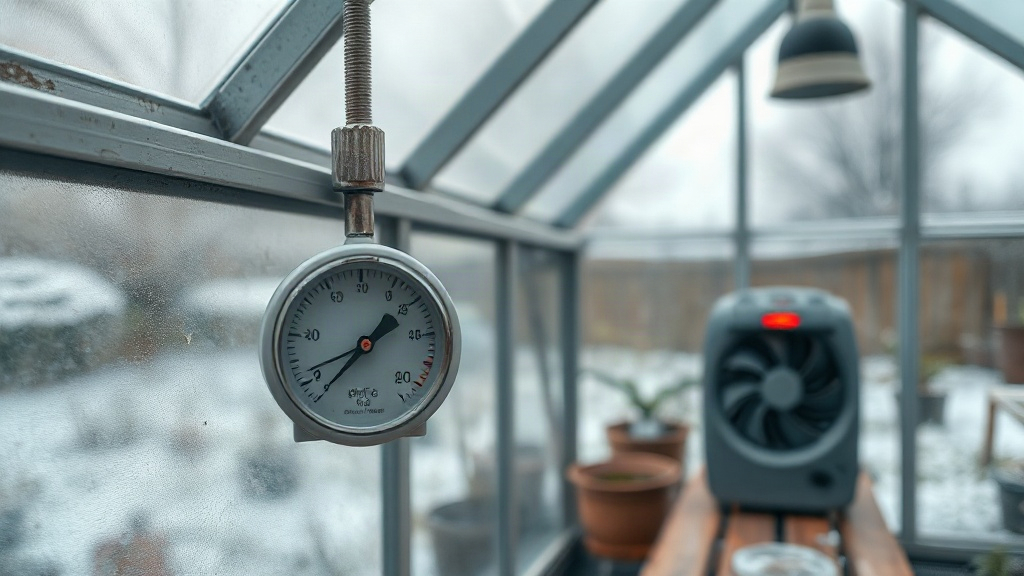
Analogue min/max thermometers have no batteries, no screen, and no app. They work entirely mechanically—a metal index marker is pushed by the mercury or alcohol column to record the high, and another tracks the low. You reset them manually by sliding the markers back to the current temperature. The big advantage is reliability: they never run out of batteries, they never need charging, and they can’t fail because of a power cut. For winter frost protection, where a battery failure at 3 AM could mean losing your entire collection of tender perennials, that reliability matters enormously.
Digital models add a screen that displays the current temperature plus the recorded high and low. Some also include humidity. The convenience is genuine — you can see the swing without sliding a marker back. A Brannan digital max-min thermometer (paid link) is that instrument. It is not a room humidity meter.
Check Brannan digital max-min thermometer price → (paid link)
Our verdict: for critical winter frost protection, an analogue model wins because it requires no batteries and cannot fail silently. The TFA Dostmann max-min thermometer (paid link) represents the analogue approach—reliable, simple, and purpose-built for exactly this job. For daily summer monitoring where you’re checking ventilation and shading, digital is more convenient and the battery risk is negligible.
Check TFA Dostmann max-min thermometer price → (paid link)
The honest trade-off is this: analogue models require a manual reset every time you want to clear the records and start fresh. If you’re the sort of person who will remember to do that, great. If not, the digital readout is clearer and harder to ignore. Many greenhouse owners find resetting an analogue thermometer becomes a simple habit, similar to checking water levels during visits.
For anyone running a greenhouse heater over winter, pairing it with a reliable min/max thermometer is non-negotiable. The heater’s thermostat needs accurate data to work properly, and you need that overnight low record to know whether your insulation strategy is actually holding.
Getting placement right
You can spend £80 on the most accurate thermometer available and get useless data if it’s mounted in the wrong place. Placement is where most greenhouse temperature monitoring goes wrong, and it’s the factor that professional growers and the RHS consistently emphasise.
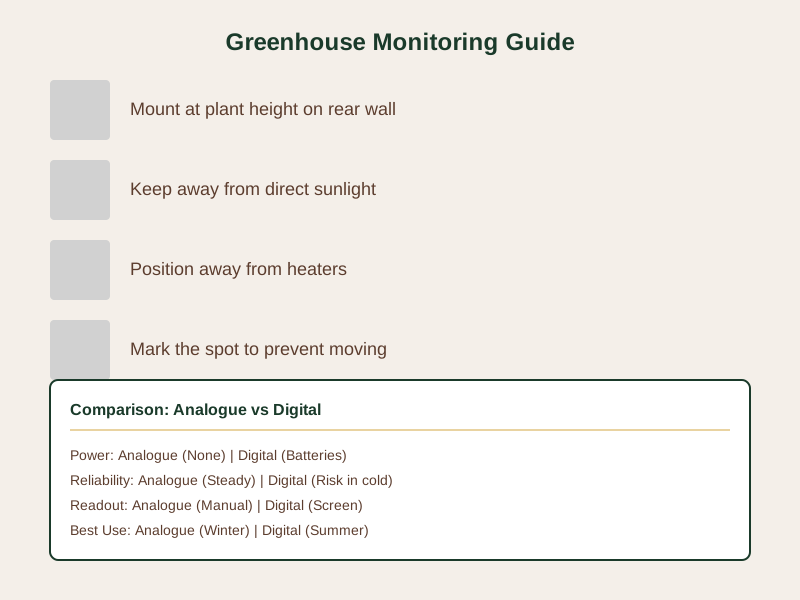
The correct position is at plant height on the rear wall of the greenhouse, away from direct sunlight, and away from any heater. This sounds simple, but it’s counterintuitive—most people instinctively put the thermometer near the door or next to the heater where they can see it easily. That placement tells you the temperature in those specific spots, not the temperature your plants are actually experiencing.
The RHS guidance on greenhouse monitoring is clear: the thermometer should reflect conditions at plant level, not at heater level. A reading of 15°C next to a paraffin heater while the far end of the greenhouse sits at 2°C is worse than useless—it gives you false confidence. Plants at the back of the greenhouse, furthest from the heat source, are the ones at risk, and they are exactly what your thermometer should be monitoring.
Place the thermometer at plant height, mounted on a vertical surface at the rear wall. It should be shaded from direct sun by the structure itself or by a nearby plant. If you grow directly on the ground rather than on staging, move it down to soil level. The principle is always the same: wherever your most vulnerable plants are, that’s where the thermometer goes.
One of the most common mistakes is repositioning the thermometer to somewhere convenient—on the door frame, on the staging—and then forgetting it was moved. If you’ve ever checked a reading and wondered why it seemed fine when your plants looked stressed, this is usually why. Mark the position with a small label or clip so it never moves.
Additional monitoring considerations
For most greenhouse owners, monitoring the air temperature at plant height covers everything they need. But there are two additional measurements worth knowing about for specific situations.
Soil temperature matters for root health. If you’re overwintering plants in pots or propagating from cuttings, the root zone temperature is what counts—roots are far more sensitive to cold than the air above, and a plant that looks fine above ground can be sitting in soil cold enough to cause root damage. A basic soil thermometer pushed into the compost gives you that reading. It’s not a replacement for the air thermometer; it’s the missing half of the picture for serious overwintering.
Thermo-hygrometers—devices that measure both temperature and humidity—are worth considering if you grow humidity-sensitive plants like orchids, ferns, or cuttings that need consistent moisture levels. High humidity in a cold greenhouse encourages grey mould, while very low humidity in a heated one can desiccate tender growth. The TempPro TP50 room thermo-hygrometer (paid link) shows the temperature and humidity now. It does not store the overnight minimum, so it does not replace the max-min thermometer above.
Check TempPro TP50 thermo-hygrometer price → (paid link)
Stevenson Screen thermometers are the gold standard used by the Met Office and weather stations—they measure air temperature in a white-louvred box that shields the sensor from direct sun while allowing air circulation. For a greenhouse, this level of precision is overkill unless you’re running a growing trial or need official-grade data. For the average hobby greenhouse, a well-placed min/max thermometer does the job perfectly.
Common questions answered
Do I need a digital or analogue min-max thermometer?
For winter frost protection, an analogue model is the safer choice—it has no batteries to fail, and it will keep recording accurately through a power cut or cold snap that kills digital devices. For daily summer monitoring where you’re checking ventilation regularly, digital is more convenient and the battery risk is irrelevant. Many greenhouse growers keep both: an analogue near the plants for the overnight record, and a digital on the staging for quick daytime checks.
Where should I hang the thermometer in my greenhouse?
Mount it at plant height on the rear wall, away from direct sunlight and well away from any heater. The idea is to read the temperature that your plants are actually experiencing, not the temperature right next to the heat source. If you use staging, position it just above the staging level. If you grow directly on the floor, lower it accordingly. Mark the position so it never gets moved.
What is the ideal temperature range for a greenhouse?
Greenhouse plants generally thrive in moderate temperatures. Frost-tender plants face risk when temperatures approach freezing, while very high temperatures can stress even hardy plants. The min/max record tells you whether concerning temperature thresholds have been breached and, crucially, when.
Analogue vs Digital Min-Max Thermometers
| Feature | Analogue | Digital |
|---|---|---|
| Power Source | No batteries required | Requires batteries or charging |
| Reliability | Cannot fail due to power cut | Risk of failure during cold snaps |
| Readout | Manual reset of markers | Automatic display on screen |
| Best Use | Critical winter frost protection | Daily summer ventilation checks |
Making your choice
A thermometer that only shows you the current temperature is like a speedometer that only tells you how fast you’re going right now—useful information, but not the information that keeps you safe. The overnight low and the midday high are the numbers that tell you whether your plants survived the night and whether your ventilation is adequate for a sunny afternoon.
The key distinction comes down to readout accessibility: choose a model with a remote sensor or outside readout if you want to check temperatures without entering the greenhouse, or stick with a basic dial if reliability matters more than convenience. For putting those readings to practical use, our frost-protection guide shows how to interpret the data.
The overnight number only matters once you know which plants it will hurt. That match is in how to protect greenhouse plants from frost .
Related reading
- How to Protect Greenhouse Plants from Frost
- Electric Greenhouse Heaters With Thermostat
- Running Costs of Greenhouse Heaters UK
As an Amazon Associate we earn from qualifying purchases. The products linked above are ones we think are worth a look.
Note: General guidance only, verify details with a qualified professional or official source.